Altitude
14,000
FT AGL
EXIT
SkyTales
13,000
FEET ABOVE THE GROUND
Scroll to fall
The orange bulb goes green.
The door slides open.
A thin cold wind moves through the cabin.

Ready. Set. Go.
13,000 ft · The Exit

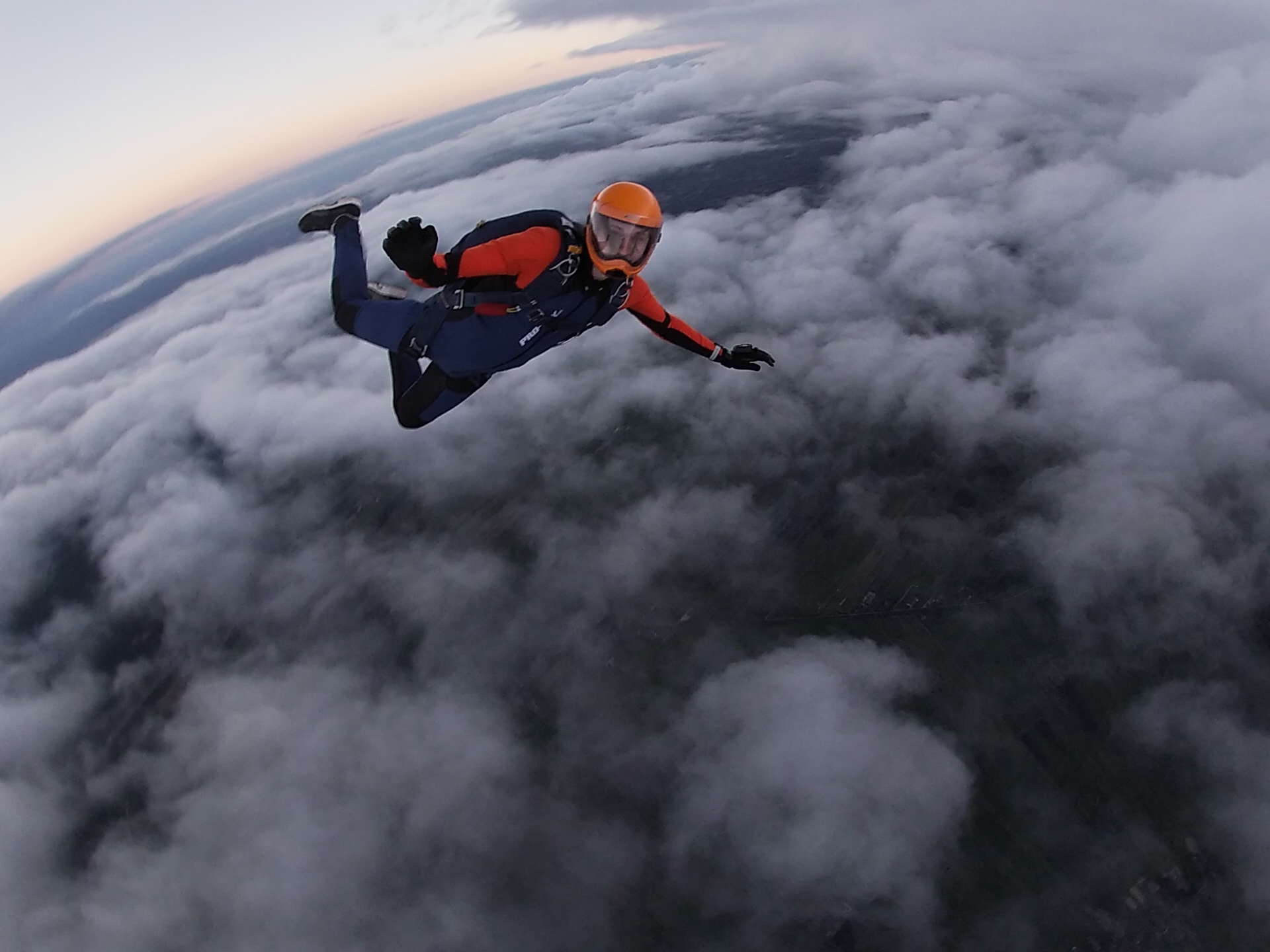
I jump out of planes.

Not as a metaphor. Literally. You rehearse the dive plan on the ground. Exit, drills, breakoff altitude, pull altitude. You intend to stay within its bounds.

Then, right on cue, you put your head out into 160 km/h of relative wind and the plan shatters. Conscious control leaves the aircraft the same second you do. Automation takes over and you fly on instinct. The first seconds overload the senses so completely that hearing shuts down. Your brain tries to compute the distance to the ground and fails.

That state, a mind meeting a system too complex to intuit, is the same state I am in staring at the Schrödinger equation. Or watching a neural network converge. Or tracing the boundary of the Mandelbrot set.

The overload is the point. It means you found something worth understanding.

Altitude check: 13,000 ft
9,000 ft · Freefall

I build the simulations.
Jasper Taal

I'm Jasper. I studied life sciences before getting a master's in bioinformatics with a focus on artificial intelligence. I stare at equations until they become pictures.

I make interactive visualizations. Black holes bending light. Gradient descent on a loss surface. A wavefunction interfering with itself.

Simulations, not videos. They run in your browser. The parameters are yours and the consequences are immediate. The sliders go past where it is polite. If the math breaks, you get to watch it break.

Over fifty so far. Every one of them started as an exploration.

Black Hole
Neural Networks
Turing Patterns
Quantum
Riemann Zeta
Chaos Theory
Fluid Dynamics
Diffusion
Convolution
56+
Visualizations
13
Categories
1
Person
Altitude check: 3,500 ft
At 3,500 feet, you pull.

1001
1002
1003

The canopy catches air.
Chaos becomes order.

That's what a good visualization does.
Lattice Boltzmann CFD simulation of parachute canopy fluid dynamics

Lattice Boltzmann method, canopy fluid dynamics

1,500 ft · Canopy

Why this exists.

Under canopy the world slows down and goes quiet. Blissfully quiet. You grab the toggles and take control. It is beautiful and it is technical: reading the wind, flying the pattern, picking the landing point. But the thing doing the actual work never shows itself. The air hides its own mechanics. Even the silence is partly its work: a pressure difference your middle ear has not caught up with yet. You feel it in the harness and see it nowhere.

Except in one place. The animation above is that air. A lattice Boltzmann simulation of the flow around a canopy, computed cell by cell: pressure, vortices, wake. The thing you feel in the harness, drawn.

That is the job. Take the part of a system that works unseen and put it on screen, with sliders attached and the formula rendered full size. Drag a coefficient. Push past the stable region. Watch it come apart, bring it back. Look closely and you'll see principles emerge.


The Maxwell Boltzmann distribution. Every cell of the canopy simulation relaxes toward this: velocities in a bell curve around the local flow .
Underneath the turbulence, a Gaussian.
0 ft · Landing

Where this is going.

SkyTales is one person and a skydiving habit. Understanding should be free, so everything here is.

It all runs in your browser. No installs, no subscriptions, no login walls. The door is open.

Next: learning paths from vectors to transformers. More simulations, further past the textbook limits.

If you want to help make that happen, there is a button below.

A living automata.